

For years it’s bothered me, and the explanation still annoys me,
I can’t find a picture of just two bright spots after its being observed.
So why can’t we get a video of non observation giving the wave form then, begin observing and see it shift to two bright spots?
I have no qualifications to talk about any of this but could it be because a photon is massless they just kinda always move through on an odd angle?
They can also do it with electrons, could that just be electrons somehow passing a charge off to the slit then pushing them around?
My current understanding is that the reason we can’t see the two bright spots rather then the wave is its just a thought experiment rather then an observable phenomenon.
I’m dont expect answers really but it just kinda drives me mad at night
You’re missingerpreting what the 2 slit experiment is.
Have a wall with two slits and a white wall in front of it, fire a single paint ball at that wall. Observe where the ball hit the wall. Now fire another. Now another. Keep going until a pattern emerges.
This is what you expect from paint balls or grains of sand:

That’s an extreme representation, in reality some balls will hit in different locations, but that’s the image you expect to be formed by the majority of the hits.
However when you fire photons or electrons, the image you get is different, like so:

That second image sort of makes sense if you were firing millions of particles at the same time, because ones going left, and ones going right would hit each other and fall before reaching the wall, thus interfering with one another. But that’s not the case, you’re firing a single electron/photon at a time (and only getting a single marker on the wall behind).
This is an actual image of the experiment result:

As you can see, it’s not perfect, but it behaves as a wave (i.e. as a bunch of particles colliding with one another), even though you’re only sending one at a time. The only explanation is that the particle went through both slits and interacted with itself.
So someone thought, but what if we measured which slit it goes through? Then we can trace where each ball came through and get a better idea. The moment they turn the detector on the particles behave like paintballs:

That’s what makes this weird, if you trace their paths they behave like particles, if you don’t they behave as waves.
How does that detector work? How is capable of detecting individual photons without absorbing them? Wasn’t that part a thought experiment?
Great explanation
trace their paths they behave like particles,
It’s not so weird in that for the device to measure which path it has to interact with the photon.
Like trying to measure where a ping pong ball will roll on a table when your only method of looking at it is to shoot the ball with a machine gun and then examine the bullets. Of course the bullets are going to knock the ball of its original path.
And thus the fundamental limitation of quantum mechanics: What is a measurement?
Yes, you are absolutely correct, and that does help explain where the observer effect comes from, there’s no way to observe without interact and that’s something I think most people miss. I had a teacher that gave a very similar example to yours, he said “imagine your way of seeing the world is by throwing tennis balls in front of you and measure the time it takes them to come back, you could easily measure a chair like this, now try to measure the position of a ping-pong ball”.
That being said, the measurements interference alone doesn’t make the wave behave like a particle, you should get the same interference pattern only slightly shifted by your measurement equipment interference. For example, if you use a magnet to measure the electrical field generated by the moving electron, that would pull the electron towards/away from the magnet, but it should still interact with itself. What’s weird is that by measuring it on one slit it ceases to interact with the version from the other slit (since it never went there sort of speak).
What’s weird is that by measuring it on one slit it ceases to interact with the version from the other slit (since it never went there sort of speak).
I like Feynman’s explanation in QED. Each particle has clock (phase). This causes interference patterns. If you measure it at the slit, it means one photon hit a detector in the slit and a new photon was emitted out the slit so the clock (phase) is reset.
Because observation in quantum mechanics doesn’t mean “some human looked at the pattern”, but rather “some.device was used to measure the particles”
It’s probably the worst communicated scientific assertion in all pop science.
I think one of the reasons is that they usually try it with individual particles. So there really isn’t one bright spot to show, only a photo paper or similar with accumulated spots.
not only can we see the 2 slit exposures, we can see 3 when they pushed it to 3 slits
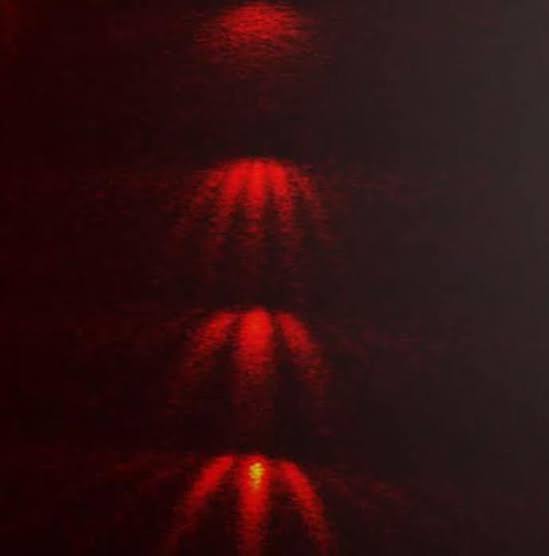
But still a wave form


